(Slack)tivism?
Social media is being increasingly used to raise awareness for a diverse range of causes. Is it actually any good at inciting lasting change? And is it always to be trusted?

Kindling
On December 17th 2010 a man set himself on fire. His name was Mohamed Bouazizi, and he was a vegetable seller in a small town in Tunisia called Sidi Bouzid. He had an unlicensed vegetable cart which had been confiscated multiple times before. The final time it was confiscated he was slapped, and his dead father insulted.
Sidi Bouzid is far removed from the coastal cities of Tunisia. Poor infrastructure, poor facilities and local corruption had left the people frustrated, simmering with resentment.
Mohamed Bouazizi went to the local adminstration centre to argue his case, but was refused to be seen. An hour later he doused himself in a can of petrol and set himself alight. He was 26 years old, and was the main source of income for a family of eight. He died of his injuries a few days later.
![In a photo from January 2011, Tunisian protesters demonstrate beneath a poster of Mohamed Bouazizi, near the prime minister's office in Tunis [File:Salah Habibi/AP Photo]](https://substackcdn.com/image/fetch/$s_!a9P2!,f_auto,q_auto:good,fl_progressive:steep/https%3A%2F%2Fbucketeer-e05bbc84-baa3-437e-9518-adb32be77984.s3.amazonaws.com%2Fpublic%2Fimages%2F147abcfa-05dd-4b56-98ec-cf5d3d3cdcf7_770x513.jpeg "In a photo from January 2011, Tunisian protesters demonstrate beneath a poster of Mohamed Bouazizi, near the prime minister's office in Tunis [File:Salah Habibi/AP Photo]")
Fire
“Modern networked movements can scale up quickly and take care of all sorts of logistical tasks without building any substantial organizational capacity before the first protest or march.” - Twitter and Tear Gas: The Power and Fragility of Networked Protest
Thousands of people showed up for Bouazizi’s funeral. Protests spread throughout the Sidi Bouzid province. Social media was filled with images of protestors. Internet campaigns urging protests led to numerous professions including lawyers, doctors and trade unions going on strike. The president Zine al-Abidine Ben Ali fled a few days later.
"We use Facebook to schedule the protests, Twitter to coordinate, and YouTube to tell the world" - Egyptian Protestor, 2011
The impact of social media spilled over to other countries. Throughout 2011 and 2012 President Mubarak in Egypt, General Muhammed Gaddafi in Libya and Ali Abdullah Saleh in Yemen were all swept from power. The Arab Spring, as it was called, also began to be called “Facebook Revolution”.
Embers
“I’m a dog chasing cars. I wouldn’t know what to do with one if I caught it.” - The Joker in The Dark Knight
As quickly as the wave of protests built up, it broke. The protests, lacking a clear direction, disintegrated into vying factions struggling for power. The Arab Spring provided hope for many people, but is now seen by others as a cautionary tale. Aside from no formal leadership, there was no scope to make collective decisions to changing circumstances. What would happen when they had achieved their goals?
Using social media platforms also leaves movements open to be used for commercial gain, and even can allow censorship. The latter issue was seen more recently when the Russian Government placed increasing pressure on social media within Russia to quell any online protests about the treatment of recently imprisoned opposition leader Alexei Navlany1.
New growth
The first time #BlackLivesMatter appeared on social media was a 2013 Facebook post by Alicia Garza after George Zimmerman had been acquitted of the murder of Trayvon Martin.
“stop saying we are not surprised. that's a damn shame in itself. I continue to be surprised at how little Black lives matter. And I will continue that. stop giving up on black life. Black people. I love you. I love us. Our lives matter.” - Alicia Garza, co-founder of Black Lives Matter (BLM)
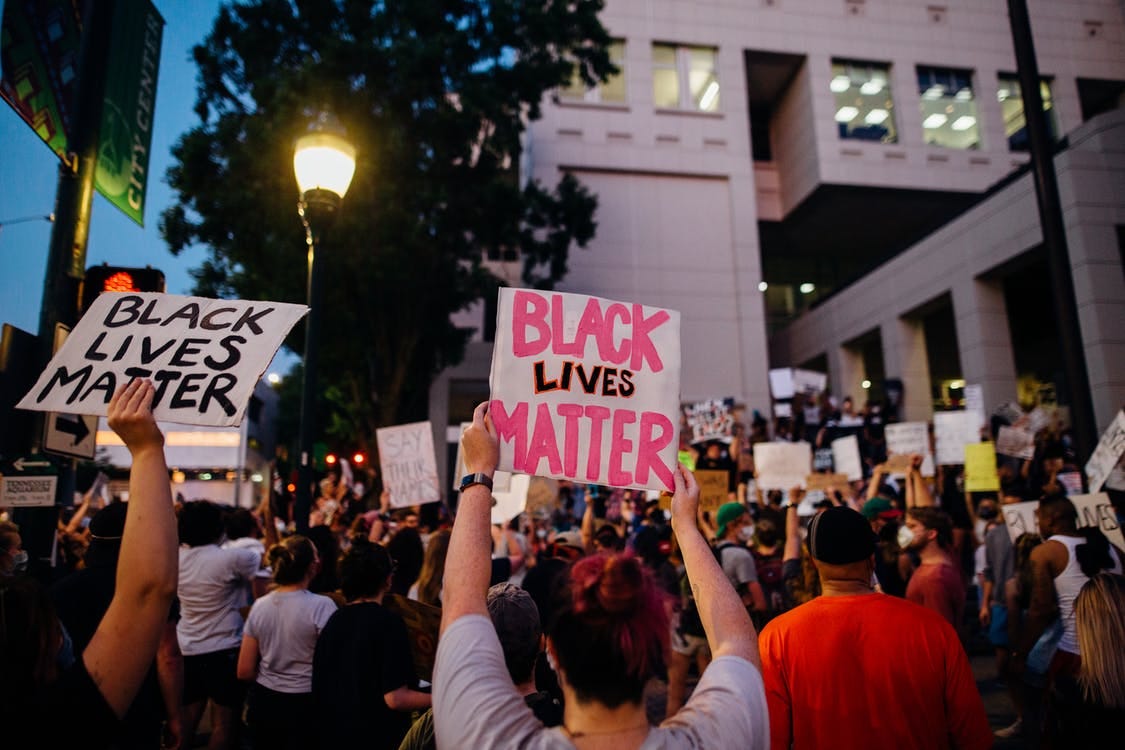
As more stories of African-Americans being affected by police brutality became known the #BlackLivesMatter hashtag became exponentially popular throughout social media. It hit a peak of awareness after the murder of George Floyd on May 25th 2020 by policeman Derek Chauvin, and sparked widespread protests throughout the US and through the world. This movement did not dissipate quickly however.
Activists organised. Social media was used to distribute protest guides, webinars and further reading. They had a purpose and a goal in mind. Whilst they presented sleek infographics on Twitter and Instagram they used Google Drive and Slack to create and co-ordinate social media content and policy in co-ordination with activists throughout the world. Lasting changes have been made, and the BLM movement continues to flourish throughout the virtual, and physical world.
Infodemic2
We live in a society where the physical and virtual are increasingly enmeshed. This has become even more so throughout the COVID-19 pandemic. Our use of social media has gone up accordingly3. People are increasingly using social media to find out about current affairs. This allows people who may not have the chance to be on mainstream media to be seen and heard. Whilst this allows marginalised voices to be heard, it also allows for false information to be distributed. An example is that of fascists who hijack eco-friendly messages to push their agenda.
“In their social media posts, ecofascists use apparently benign emojis such as a pine tree, an Earth and a mountain accompanied by subtle far-right dog-whistle symbols such as Norse runes and ideological hashtags.”4
The amount of information means that it cannot be fully controlled. #BlackoutTuesday was launched by the music industry in solidarity with the protests for George Floyd. Whilst it cut across most platforms and drew huge awareness of the cause, it also muted information about resources and events.
Juxtaposing these images of protest alongside more mundane posts also trivialise these causes, and over-exposure to similar themes saturates those who interact with them. Social media also keeps us in our own social circles, and this is not conducive to productive discourse as everyone will share similar viewpoints. As social media activism becomes more integrated into our lives, its power to generate conversation reduces to a starting point rather than the whole discourse.
“And that’s basically the meme: it’s the headline.” - Deva Woodly, professor of politics at the New School5
Lessons
How do we become better at engaging with activism on social media?
Check the source - In an age of fake news a lot of information may be fraudulent. If you have a vested interest in the cause, read into it before engaging more deeply.
Seek the source - Whilst posts may have been shared by celebrities, working to find the original activists who created the post and engaging with them directly allows them to be heard more loudly.
Support the source - If it impacts you, do something about it. Sharing it is a starting point, but take it from the virtual into the physical. This can be from donating towards the cause, talking about it in social circles, and organising and attending events in support.
I wrote this article in response to the posts about Palestine on my social media platforms. I saw all of these videos and infographics, but did not know how to engage with them in a productive manner. I hope this post will provide a bit further clarity on how to do that, as it did for me.
Thanks,
SBR
https://www.hrw.org/news/2021/02/05/russia-social-media-pressured-censor-posts
https://www.un.org/en/un-coronavirus-communications-team/un-tackling-%E2%80%98infodemic%E2%80%99-misinformation-and-cybercrime-covid-19
https://datareportal.com/reports/digital-2020-july-global-statshot
https://www.bbc.com/future/article/20200915-the-subtle-ways-that-clicktivism-shapes-the-world
https://www.newyorker.com/culture/cultural-comment/the-second-act-of-social-media-activism
Nicely put, your point probably resonates with all of us: 'Social media also keeps us in our own social circles, and this is not conducive to productive discourse as everyone will share similar viewpoints.' We now have our own echo chambers to access at any given time, for any given issue, and the polarisation just gets more and more intense!